Thursday, 10 March 2016

BIG OIL - Is There a Future?


World Will Need Big Oil


World will need big oil thumbnail
There are those who will tell you that this is a bad time to be running a big oil company. John Watson, chief executive of Chevron, is not among them. “Arguably, we’ve never been more advantaged than right now,” he says.
Of course, he acknowledges, times are tough for everyone in the oil industry because of the plunge in prices for crude and natural gas since the summer of 2014.

Compared to his competitors, though — whether the smaller independent oil producers in the US or the big national oil companies in emerging economies — Chevron is better placed to ride out the downturn and benefit from the upturn when it comes, he believes.
Critics of Chevron and the other big international oil companies suggest their business model is under threat, trapped in a pincer movement between the leaner and more agile shale operators, and curbs on demand for oil and gas imposed by government policies to reduce the threat of climate change.

In an interview with the Financial Times, Mr Watson, a 36-year Chevron veteran, rejects that critique. “I expect [Chevron] to be a viable and vibrant business for a long time,” he says. “There is still a good connection between economic growth, prosperity and consumption of energy. And we’re going to need all forms of energy.”

Chart: Oil majors' performance
With oil at $52 per barrel, which was the average price of Brent crude last year, Chevron does not look like a business with a great long-term future.
Its return on capital employed last year was just 2.5 per cent, and its cash outflows including capital spending and dividends exceeded its cash from operations by $22.5bn. Over the past five years, the company’s shares have significantly underperformed the S&P 500, reflecting a squeeze on profitability that began even before the slump in oil prices.
Mr Watson, however, argues that the factors that determine Chevron’s financial position will “come together pretty nicely for us over the next year or so”.

Between 2009 and 2012, Chevron embarked on an extraordinary investment binge, committing to a wave of very large projects. At its peak in 2014, its capital and exploration spending exceeded that of its rival ExxonMobil, even though Exxon’s market capitalisation was more than 80 per cent greater.

Chevron CEO John Watson

John S. Watson...John watson, Chief Executive Officer and Chairman of the Board of the Chevron Corporation in New York City
Now Chevron’s large projects are reaching completion. Gorgon, the $54bn liquefied natural gas development in Australia that is the largest of them all, is expected to ship its first cargo next week.

Others, including Wheatstone, another big LNG plant in Australia, and Big Foot, a deep water oil development in the Gulf of Mexico that was delayed by equipment failure, are coming on stream over the next couple of years.

As a result, Chevron’s oil and gas production is expected to grow by 13 per cent between 2015 and 2017, and continue increasing by about 1 per cent per year after that. Exxon’s production, by contrast, is expected to be roughly flat out to the end of the decade.

“As we finish those projects that are under construction, our capital spending will come down, and we get the added benefit that as those projects are coming on line, we will generate more cash,” says Mr Watson.

Due to cost-cutting, with 7,000 jobs going during 2015 and 2016, and the completion of those large projects, Chevron expects to be able to cover its capital spending and its dividend payments from its cash flows next year if oil is again at $52.

If oil is lower than that — Brent crude is this week trading at about $40 per barrel — then Mr Watson is prepared to keep borrowing to pay the dividend, because its shareholder base values the “predictability” of the payout.

Part of the price of that is Chevron has put the brakes on new projects. The company did not give the go-ahead to any large developments in 2015, and this year expects to approve just one: an investment to increase production at the huge Tengiz oilfield in Kazakhstan.
Chart: Capital spending being cut sharply
Instead, Chevron will focus on much smaller investments, such as additional wells to boost production at existing projects, and development of its own shale oil reserves in the Midland and Delaware basins of west Texas.


Chevron has an excellent position there: it calculates that it could drill 1,300 wells that would be financially attractive even with oil prices below $40, and it plans for production in west Texas to double by 2020, and possibly rise even faster.

Big projects, however, are the raison d’ĂȘtre of large oil companies, which are the only businesses with the financial strength and technical expertise to develop them.

Chart: Expected US shale productionIn shale, the big international oil companies were slow to see the opportunity, and have lagged behind their smaller rivals in efficiency. Chevron says it is catching up, but if the future of the oil industry lies in shale, then the big companies seem to have no decisive competitive edge.
However, Mr Watson argues that the hold-up in large projects is just a temporary hiatus. In the short run, the global oil market is oversupplied, and may remain so for a while, because of factors including the resilience of US shale and production from Iran coming on to world markets after the lifting of sanctions.

Oil majors’ business model under increasing pressure

BP, Chevron and Exxon walk a fine line between paying dividends and investing in operations
By the 2020s, he argues that big capital projects will be needed again. Shale can provide additional supply to meet rising demand for oil for a few years, but not forever.

“Shale is roughly 5 per cent of world supply,” he says. “As you think forward . . . Shale will be insufficient to meet that demand. We will need other classes of assets.”

While times may be hard for Chevron as it waits for that upturn, he adds, others have it even worse.

“We don’t have the stresses and strains that the independents have with stressed balance sheets,” says Mr Watson. “We don’t have the stresses that national oil companies have, where they’re trying to choose between reinvesting in the business at low prices [and] trying to feed their people and meet the social obligations that they have.

“At any kind of moderate prices, we’ll be growing production through the end of the decade, with good investments going forward. Others may not have that opportunity.”


 Image result for big oil business models

Financial Times

Source:
Wednesday, 9 March 2016

Falling Rig Counts, Means Higher #OIL Prices Later


Image result for international rigs

International Rig Count Still Falling


International Rig Count Still Falling thumbnail


The rig count data in all charts below is through February 2016.

BH Total Intl.


The Baker Hughes International Rig Count does not include the US, Canada, any of the FSU countries or inland China. It does include offshore China. That rig count peaked in July 2014 at 1,382 rigs and in February stood at 1,018, down 364 rigs from the peak.


BH Total World


The Baker Hughes total world rig count does include US and Canada but not the FSU or inland China. That total oil & gas rig count stood at 1761 in February, down 52% since December of 2014.


BH US Monthly


The US monthly total rig count stood at 532 in February, down 72% from November 2014.


BH Canada


The Canadian total rig count usually peaks in February. It did not in 2015 but stood at 211 this February which will likely be the peak for 2016. That count is down from 626 rigs in February 2014, down over 66%. That was the last pre-price crash February peak.

BH Total Intl Oil Rigs


Looking at oil rigs only, total international oil rigs dropped another 28 rigs in February to 744 rigs. That is down 336 rigs or 32% since the July 2014 peak.


BH Saudi et. al.


Four nations where the rig count has not collapsed is Saudi Arabia, the UAE and Kuwait and Iraq. The huge jump you see in June 2012 was due to Iraq going from 0 rigs to 78 rigs.


BH Intl Rigs Less


International oil rigs, less Saudi, UAE, Kuwait and Iraq peaked in July 2014 and have declined 30% since that date.
But what has all this done for production… so far.


BH Intl Rigs Less ME OPEC


The production data, right axis, in the above chart is only through December while the rig data, left axis, is through February. Production fell all through the rise in rig count then began to plateau in mid 2013. The rising rig count did not increase production but the falling rig count will almost certainly cause it to decline… after a delay of one to two years of course.

Again, the above oil rig only charts does not include the US, Canada, any FSU nation or China.


Source:

Sunday, 6 March 2016

Globalization Destroys American Middle Class

Storm the Bastille


In the last analysis, globalization has only benefitted the rich and led to the quiet destruction of society and the middle class. We need to become more self-reliant. more centred in our culture and effect policies that bring middle class jobs back to North American shores.

If we fail and continue on globalization's  clear path to self destruction, then the possibility of a quiet revolution becomes a greater risk t caused by the freshly minted legions of poor middle-class folks. 

History has an odd habit of repeating itself.

"Let them eat cake' 

Free Logo From Thefreelogomakers.com


Why Globalization Reaches Limits

We have been living in a world of rapid globalization, but this is not a condition that we can expect to continue indefinitely.
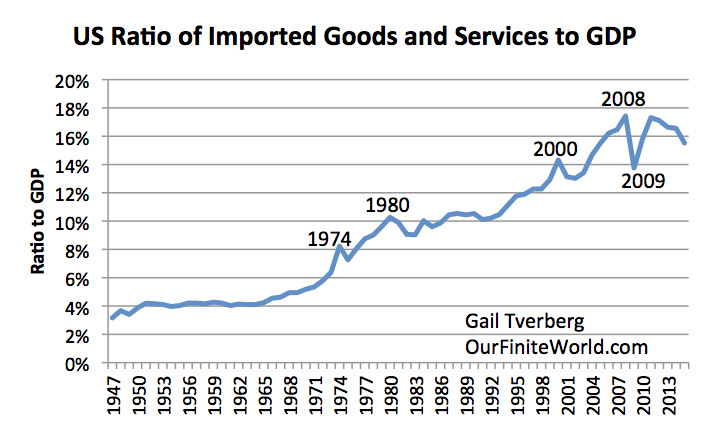
Figure 1. Ratio of Imported Goods and Services to GDP. Based in FRED data for IMPGS.
Each time imported goods and services start to surge as a percentage of GDP, these imports seem to be cut back, generally in a recession. The rising cost of the imports seems to have an adverse impact on the economy. (The imports I am showing are gross imports, rather than imports net of exports. I am using gross imports, because US exports tend to be of a different nature than US imports. US imports include many labor-intensive products, while exports tend to be goods such as agricultural goods and movie films that do not require much US labor.)
Image result for american in soup lines
 "With the People"   

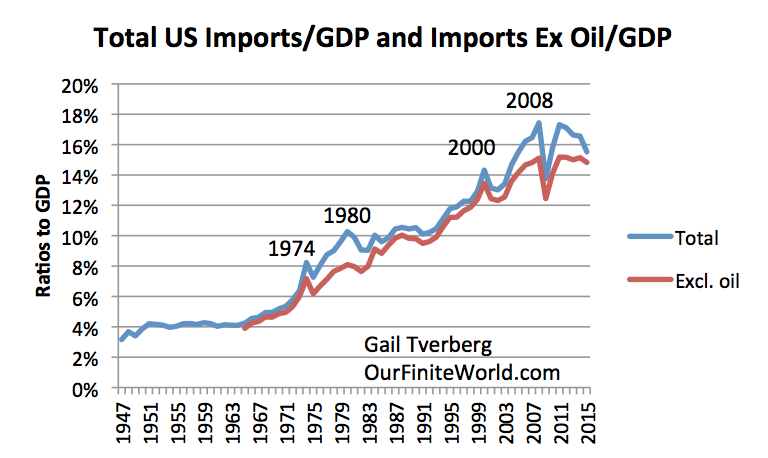
Recently, US imports seem to be down. Part of this reflects the impact of surging US oil production, and because of this, a declining need for oil imports. Figure 2 shows the impact of removing oil imports from the amounts shown on Figure 1.
Figure 2. Total US Imports of Goods and Services, and this total excluding crude oil imports, both as a ratio to GDP. Crude oil imports from https://www.census.gov/foreign-trade/statistics/historical/petr.pdf
Figure 2. Total US Imports of Goods and Services, and this total excluding crude oil imports, both as a ratio to GDP. Crude oil imports from https://www.census.gov/foreign-trade/statistics/historical/petr.pdf
If we look at the years from 2008 to the present, there was clearly a big dip in imports at the time of the Great Recession. Apart from that dip, US imports have barely kept up with GDP growth since 2008.
Let’s think about the situation from the point of view of developing nations, wanting to increase the amount of goods they sell to the US. As long as US imports were growing rapidly, then the demand for the goods and services these developing nations were trying to sell would be growing rapidly. But once US imports flattened out as a percentage of GDP, then it became much harder for developing nations to “grow” their exports to the US.
I have not done an extensive analysis outside the US, but based on the recent slow economic growth patterns for Japan and Europe, I would expect that import growth for these areas to be slowing as well. In fact, data from the World Trade Organization for Japan, France, Italy, Sweden, Spain, and the United Kingdom seem to show a recent slowdown in imported goods for these countries as well.
If this lack of demand growth by a number of industrialized countries continues, it will tend to seriously slow export growth for developing countries.
Where Does Demand for Imports Come From?
Many of the goods and services we import have an adverse impact on US wages. For example, if we import clothing, toys, and furniture, these imports directly remove US jobs making similar goods here. Similarly, programming jobs and call center jobs outsourced to lower cost nations reduce the number of jobs available in the US. When US oil prices rose in the 1970s, we started importing compact cars from Japan. Substituting Japanese-made cars for American-made cars also led to a loss of US jobs.

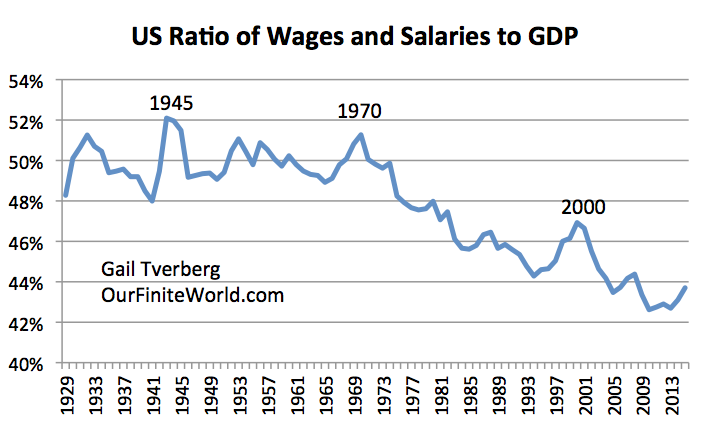
Even if a job isn’t directly lost, the competition with low wage nations tends to hold down wages. Over time, US wages have tended to fall as a percentage of GDP.
Figure 3. Ratio of US Wages and Salaries to GDP, based on information of the US Bureau of Economic Analysis.
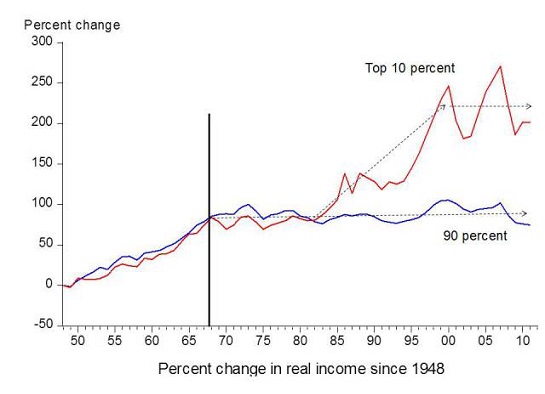
Image result for american in soup linesAnother phenomenon that has tended to occur is greater disparity of wages. Partly this disparity represents wage pressure on individuals doing jobs that could easily be outsourced to a lower-wage country. Also, executive salaries tend to rise, as companies become more international in scope. As a result, earnings for the top 10% have tended to increase since 1981, while wages for the bottom 90% have stagnated.
Figure 4. Chart by economist Emmanuel Saez based on an analysis IRS data, published in Forbes.

READ MORE

Free Logo From Thefreelogomakers.com

Tuesday, 1 March 2016

UK #PeakOil - UK North Sea Continues Production Slide

UK North Sea Oil Projects Collapse Amid Market Drop


By Danica Kirka ,AP
February 24, 2016, 12:11 am TWN


LONDON -- The number of new investment projects in the North Sea has collapsed amid a fall in oil prices, underscoring fears for the future of the basin and the jobs it creates.

Oil & Gas UK, an industry association, said in its annual survey Tuesday that some 1 billion pounds (US$1.4 billion) was expected for new projects, compared to the typical 8 billion pounds annually. It argued that the long-term future of the industry is at risk and that the government should reduce taxes "to minimize the loss of capacity in the downturn."


"We are truly trying to fight for our survival," said Mike Tholen, the economics director for Oil & Gas UK. 

Once one of the world's great oil regions, the North Sea's resources are being depleted. Production has dropped from a peak in 1999 — when the U.K. pumped 4.6 million barrels of oil equivalents a day — to 1.6 million barrels of oil equivalents a day last year. Oil & Gas UK's chief executive, Deirdre Michie, said the U.K. Continental Shelf is entering a phase of "super maturity."

That decline is being hastened by a collapse in oil prices, which have been falling for over a year. Brent crude, the benchmark for international oil, hit a 12-year low of US$27.10 a barrel in January, having been above US$100 a barrel in September 2014. It traded at US$34.46 on Monday.
The number of oil rigs being de-commissioned — that is, taken out of service and dismantled — is accelerating. The group said the number of fields expected to cease production has risen by a fifth to over 100 between 2015 and 2020.
The trade body said that if oil remains at around US$30 a barrel for the rest of 2016, nearly half of the U.K.'s offshore fields will likely be operating at a loss, "deterring further exploration and capital investment, and making additional cost improvement imperative."

With competition for investment cash fierce, Tholen argued that Britain needs to adapt the tax regime to make sure the industry can keep moving in the downturn. Tholen said thousands, if not tens of thousands, of jobs are at risk. Contractors and other suppliers rely on the industry, meaning that woes of the North Sea will be deeply felt across the country, not just in one region.

"A coherent approach by the industry, regulator and government will be critical to boost the industry's competitiveness and its investors' confidence," Michie said